

Overview
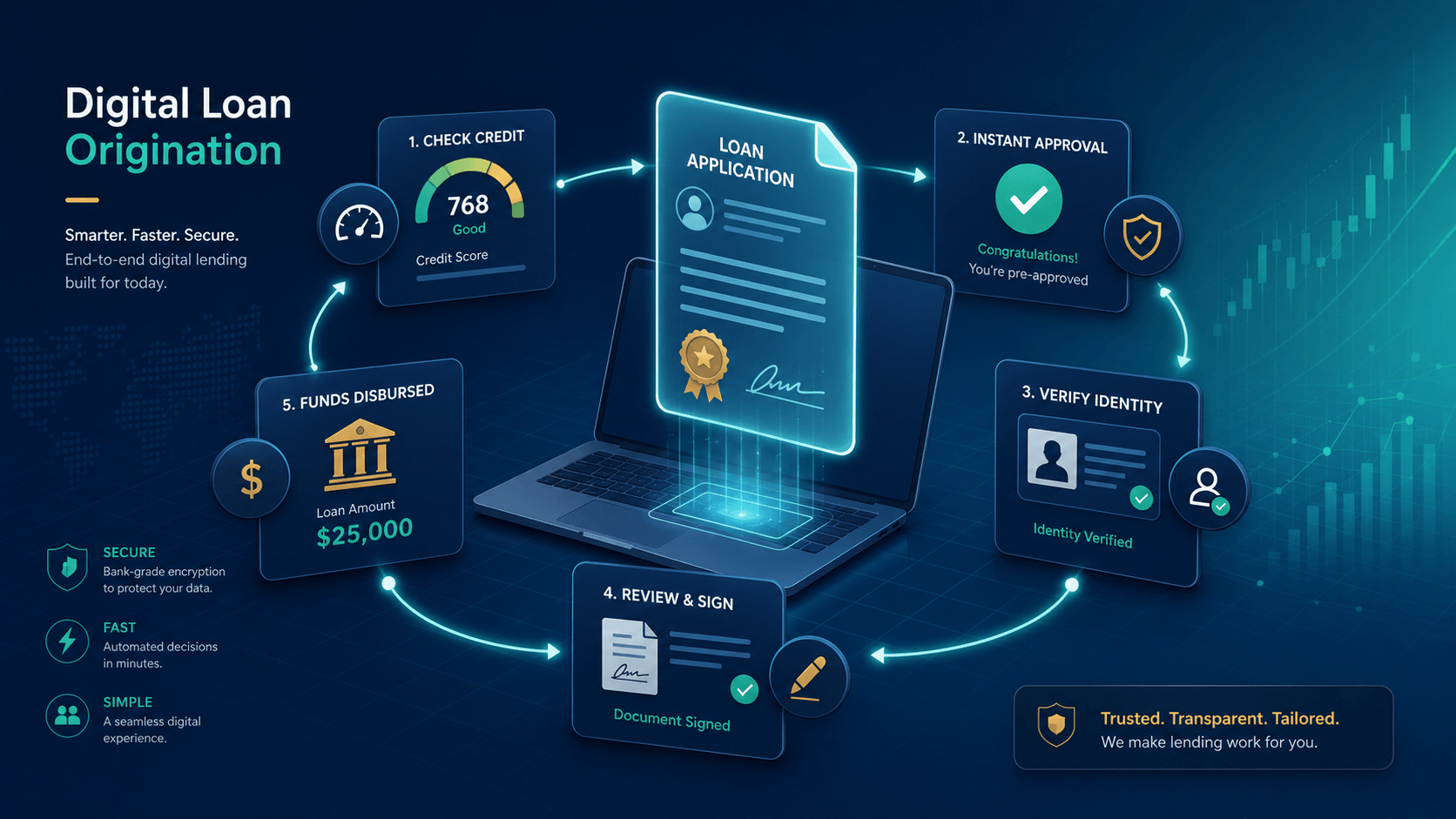
A Loan Origination System (LOS) is a platform that takes a completed loan application and facilitates the mortgage transaction from origination to post closing. LOS systems may include document management, pricing and eligibility engines, and compliance tools to decrease risk and increase loan manufacturing quality.
The journey of Loan Origination Systems (LOS) from their inception to the present day is a testament to the transformative power of technology in the financial sector. Initially, the loan origination process was heavily manual and paper-based, characterized by lengthy application forms, physical document submission, and manual verification. This not only made the process time-consuming for both lenders and borrowers but also prone to errors and inefficiencies.
As computer technology began to infiltrate the banking sector in the late 20th century, the first digital LOS solutions emerged. These early systems were rudimentary by today's standards, focusing mainly on digitizing paper forms and storing information electronically to ease retrieval. While they reduced paper dependency, these systems did little to streamline the overall loan origination process.
The advent of the internet and subsequent technological innovations brought a new wave of change. LOS solutions evolved to become more sophisticated, incorporating web-based applications that allowed borrowers to submit loan applications online. This not only expedited the application process but also introduced new levels of convenience for customers.
Modern LOS platforms can automate much of the loan origination process, from initial application to underwriting and approval. They offer robust capabilities for risk assessment, regulatory compliance, and integration with other financial systems, providing a seamless, efficient, and more accurate process. Furthermore, they enhance the customer experience with intuitive interfaces, mobile accessibility, and real-time updates on loan status.
This evolution from manual, paper-laden processes to sophisticated, technology-driven systems has not only revolutionized the loan origination process but also significantly improved the efficiency, accuracy, and speed of lending operations, marking a new era in financial services.
The Loan Origination Process
When it comes to the loan origination process, every firm uses its own unique procedure. From the software used to the quality control steps an organization requires before funding, each uses a process that works for its own needs and the needs of the clients they serve. When looking at the origination lifecycle from a holistic perspective, it is vital to evaluate all possible standpoints.
Even though each loan origination process differs, they all follow seven distinct steps that comprise the entire loan origination system. Each of these seven steps is critical to an overall process that appropriately functions.
Stage 1: Pre-Qualification
At the pre-qualification stage, the borrower will receive a list of items needed to compile and present to the lender to move forward with the process. The list of items a borrower needs to present includes:
- Information about present employment, including the hourly pay, annual salary, and overall average earnings.
- Payment history.
- Bank statements.
After providing the paperwork, it will normally undergo processing, after which the institution will generate a loan pre-approval. The application of the prospective borrower will proceed through the loan origination system.
Stage 2: Loan Application
The borrower is responsible for filling out the loan application at this point in the process of the loan origination system. New technologies made possible by loan origination software allow for successful registration online and through a smartphone app. You can then use the data to fit particular loan management requirements.
Stage 3: Application Processing
The application gets reviewed for consistency and completeness after being received by the credit department. A smart loan origination system or LOS can automatically indicate files without the necessary data and return them to the borrower.
A smart, high-quality Loan Origination System can provide the following:
- Multiple-channel application receipt.
- Online bureau reports.
- Credit score calculations.
- Promotions like lower rates or no interest for a time.
- Automatic or manual credit choices.
- Individual application rescoring.
- Automated decision-making.
- A real-time data link between origination, funding, and servicing.
- Customized underwriting workflows.
- Status, dealer, user, or underwriter-based application reports.
Stage 4: Underwriting Process
During the underwriting process, the lender reviews the application based on several factors. Many firms developed supplementary scoring standards particular to their firm or industry.
Stage 5: Credit Decision
The underwriting procedure of the loan management will determine whether the application gets granted, denied, or returned to the applicant.
- Granted: the application is granted pending approval through the quality control process.
- Denied: if specific conditions alter, such as lowering the loan balance sought or adjusting interest rates to lower payments.
- Sent back: request for more details.
Stage 6: Quality Control
Lenders put significant effort into the quality control phase of the origination system process. Here, the application gets delivered to a quality control channel where you can assess a conclusion and other crucial factors compared to domestic and foreign policies and standards.
Stage 7: Loan Funding
Consumer loans begin to pay off soon after the loan agreement gets finalized and signed. A robust loan origination software can monitor financing to ensure that the required paperwork is signed before or concurrently with the loan management process.
Key Components of a LOS and the Benefits it Brings
Loan applications can be a long process. Luckily, loan origination software makes the application process and the loan processing itself a lot easier.
One System
Your LOS should be one system that captures every loan application no matter the source, whether it is mobile, branch, call center, indirect, retail, or kiosk, into a processing system that applies the same rules and workflows ensuring continuity for staff and consumers.
Application Processing
Streamlining the application process is paramount for both borrowers and lenders alike. Implementing early validations and automated checks significantly streamlines the workflow, saving valuable time for all involved parties. Recognizing that loan applications vary widely in terms of the data and checks required, a sophisticated Loan Origination System (LOS) should possess the agility to adapt to different loan types. This adaptability ensures that each application is processed swiftly, accurately, and without errors. By catering to the unique requirements of various loan requests, the LOS enhances its reliability, enabling lenders to offer a more efficient and error-free application experience.
Underwriting and Credit Decisioning
A LOS automates the collection and analysis of borrower data, including credit scores, financial statements, employment history, and other relevant information. By automating these tasks, the system reduces the time and effort required for manual data entry and analysis, allowing underwriters to focus on more complex decision-making aspects.
By integrating credit decisioning models, an LOS can provide immediate recommendations on loan approvals, conditions, or denials based on predefined criteria and scoring models. This automation speeds up the decision-making process, ensuring that borrowers receive timely responses. Additionally, it maintains consistency in credit decisions, reducing the potential for bias or errors.
A robust LOS allows lenders to customize underwriting guidelines and criteria based on their risk appetite and lending policies. This flexibility ensures that the underwriting process aligns with the lender's strategic objectives, market focus, and regulatory environment.
Comprehensive Document Management System
A comprehensive Document Management System plays a crucial role within a Loan Origination System (LOS) by streamlining the handling, storage, and retrieval of loan-related documents. This integration ensures that all documents, from application forms to financial statements and legal paperwork, are securely managed and easily accessible throughout the loan process. By automating document collection, indexing, and storage, the system minimizes manual errors and enhances efficiency, enabling faster processing times and reducing the loan cycle length. Additionally, it supports regulatory compliance by maintaining a detailed audit trail of document updates and access, ensuring that lenders can quickly respond to audit requests and regulatory inquiries. Overall, a comprehensive document management system within an LOS significantly improves the loan origination process's accuracy, security, and speed, benefiting both lenders and borrowers.
Core System Connectivity
Bilateral connectivity into your core system from your loan origination system is vital, meaning that it will send and receive data from the core system to the LOS. This feature saves time throughout the application process by removing manual work, reduces errors, and helps improve consumer satisfaction by creating a better application process.
Third Party Integrations
Having a large pool of third-party integrations will give you the opportunity to customize your system to use the services that your team is familiar with and best aligned with your processes.
Conclusion
Loan origination software automates your day-to-day operations, streamlines the credit calculation process, and helps process large amounts of data. The solution should cover all credit phases, from the application, calculation, decisioning, through the loan conclusion, termination, and settlement.
As we continue to explore the vast landscape of loan origination and the pivotal role of technology within it, I invite you to join me on this enlightening journey. Whether you're a fellow industry professional with insights to share, or you're seeking solutions that align with your specific needs, your perspectives and challenges are invaluable. Together, let's delve deeper into the innovations shaping the future of financial technology.